
Wine storage guide · 6 min read
When a Sub-Zero wine column drifts warm in Sonoma wine country
In a valley that takes its cellar temperatures seriously, a Sub-Zero wine column drifting a few degrees matters. The dual-zone faults we see most in Sonoma — and how each is fixed.
Few places notice a wine cooler losing its grip faster than Sonoma. When the cellar is half the reason the kitchen was built — the estate collection out on the valley floor, the case of Carneros pinot a neighbor poured last harvest — a Sub-Zero wine column that has drifted three or four degrees warm is not a small thing.
Sub-Zero builds genuine built-in and integrated wine storage, separate from its refrigeration and from Wolf's cooking line, and the failures it shows are their own breed. Here is what we actually find behind the warm zone on a Sonoma service call.
Dual zones, and why one half drifts
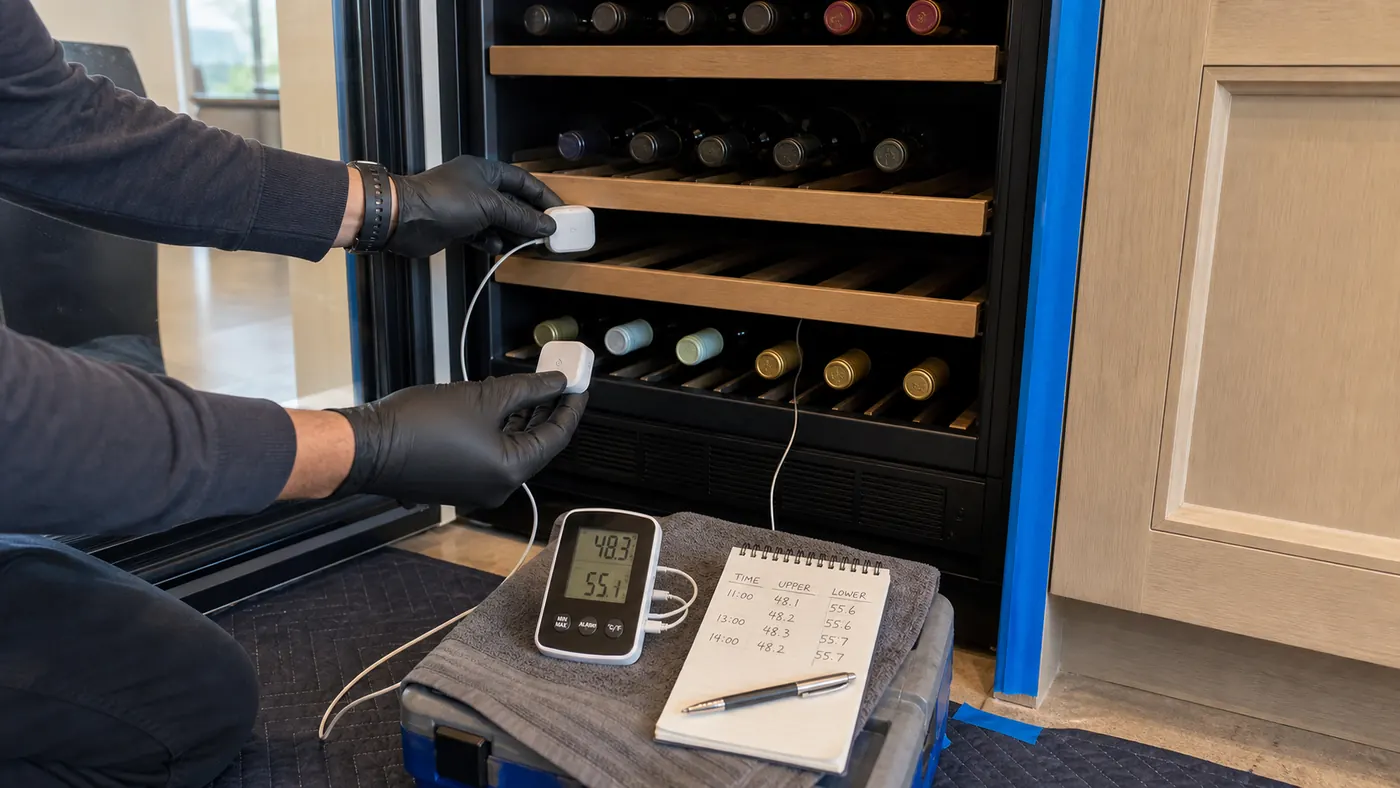
Most of the columns out here are dual-zone — a cooler upper for whites and a warmer lower for reds, each holding its own setpoint. When only one zone wanders while the other holds steady, the problem is rarely the compressor; it is the control for that zone. A failing zone thermistor reads the air a few degrees off and the unit faithfully corrects to the wrong number, or the damper that meters cold air into the warmer zone sticks and lets too much through. Both imitate a dying unit and both are bounded repairs once the readings point to them. The fix starts with putting an accurate thermometer next to the sensor and seeing which one is lying.
The sealed system, the condenser, and a Sonoma summer
When both zones drift warm together, look at the cooling side. A Sub-Zero wine unit runs a small sealed system — compressor, evaporator, and a condenser that has to shed heat into the room. In a butler's pantry or a tucked-in spot off a Sonoma kitchen that bakes through a dry August afternoon, a condenser matted with dust simply cannot reject heat fast enough, and the whole cabinet creeps up. We pull and clean the condenser, check the evaporator fan that moves cold air across the bottles, and only then put gauges on the sealed system. A genuine refrigerant leak or a tired compressor is the expensive end of this, and we show you the pressures before we ever call it.
Seals, vibration, and the things wine notices
Wine is fussier than food about the small stuff. A door gasket that no longer seals lets warm valley air seep in along the bottom and forces the unit to run constantly. The UV-tinted glass and its perimeter seal matter too — a compromised seal is both a humidity and a light problem for a collection meant to age. And vibration, easy to overlook, is real: a worn fan bearing or a compressor mount gone hard transmits a low hum into the rack that, over months, stirs the sediment in older bottles you laid down to rest. We replace gaskets, re-seat or renew the glass seal, and quiet the vibration at its source rather than masking it.
On the repair-or-replace question, the math favors repair more often than owners expect. A sensor, a damper, a gasket, a condenser clean, a fan — these are well-stocked, bounded jobs on a unit built to run for the long haul. It is usually only an older cabinet facing a major sealed-system repair where we will put the numbers in front of you and talk honestly about replacing.
FAQ
Questions & answers
Only the lower zone of my wine column is warm — is the unit dying?
Almost certainly not. When one dual zone drifts while the other holds, the cause is usually that zone's thermistor reading off or a stuck air damper, not the compressor. Both are bounded repairs once we verify the sensor against an accurate thermometer.
Does Sub-Zero really make wine coolers, or is that Wolf?
Sub-Zero builds the wine storage — dedicated built-in and integrated wine columns and undercounter units. Wolf is the cooking side (ranges, ovens, cooktops). We service both, but your wine cooler is Sub-Zero.
Can vibration actually hurt my stored wine?
Over time, yes. A worn fan bearing or hardened compressor mount sends a constant low hum into the rack that can disturb sediment in bottles meant to age. We trace the vibration to its source and quiet it rather than leaving it to work on your collection.
Go deeper
More Sonoma guides
How Long Do Sub-Zero Refrigerators Last in Sonoma? A Lifespan and Cost Guide
A Sub-Zero built-in lasts 20+ years. Which parts age first, gasket, condenser fan, sealed system, and the repair-vs-replace cost math for Sonoma's older units.
Read the guide → Second-Home Maintenance · 6 minClosing Up a Sonoma Wine-Country Home: Sub-Zero Shutdown and Return Checklist
Closing up a Sonoma wine-country home? How to shut a Sub-Zero down safely, guard old floors from a slow leak, and bring the built-in back when you return.
Read the guide → Maintenance guide · 6 minWhy a Sonoma dry-summer kitchen makes the condenser the first thing to clean
Late-summer valley heat, vineyard dust, and a kitchen running flat-out through crush gang up on a Sub-Zero condenser. Why slow cooling out here is so often dust — and how often to clean it.
Read the guide →After the proof
Rather leave it to a specialist?
Have the failing compartment, current temperatures, and model number ready, and you will get a real first opinion — not a sales pitch.