The first question is whether the freezer alone is warm or the whole unit is drifting. That one distinction splits a defrost or evaporator-fan fault on the freezer circuit from an airflow or sealed-system problem affecting both sides — and it points us at the right repair before anyone drives out.
A Sub-Zero freezer that will not hold its cold is unsettling, because the freezer is where the expensive and the irreplaceable live — the elk a neighbor shared, the stock built up for a long weekend of guests, the overflow that would not fit in the kitchen unit. But a warm freezer is rarely the catastrophe it feels like, and it is almost never a reason to replace the appliance.
What it usually is depends on a single observation you can make before you call: is the fresh-food side still cold? If it is, the trouble lives on the freezer's own circuit and the fix is well-bounded. If both sides are soft, the cause is broader. Two Sonoma habits muddy the picture — dry-August heat that loads the condenser hard enough to imitate a compressor failure, and the second garage and utility freezers that get packed tight through harvest. The sections below sort the real faults from the false alarms.
We are an independent repair company, not affiliated with, authorized by, or endorsed by Sub-Zero Group, Inc.
What is actually going wrong
Why the freezer drifts warm
Freezer warm, fresh-food still cold
When only the freezer side drifts up while the refrigerator holds, the problem usually lives on the freezer's own cooling circuit. A failed defrost heater or thermostat lets frost build into a solid sheet over the evaporator coil until air can no longer move through it; a tired evaporator fan stops pushing the cold it does make. Both imitate a dying unit and both are bounded, well-stocked repairs once a reading points to them.
The whole unit is creeping warm
If the fresh-food side is soft too, look outward to airflow and the sealed system rather than the freezer alone. A condenser matted with the dust that settles across the valley each summer cannot reject heat, and the dry-August load on the kitchen finishes the job. That is the not-cooling path — start there before assuming the worst about the freezer.
Drawer freezers versus column freezers
A bottom freezer drawer on a French-door built-in fails differently from a tall freezer column. A drawer that no longer seals — a gasket pinched by an overpacked basket — bleeds cold and frosts at the edges; a column relies more on the air damper and even loading. Knowing which you have tells us where to look first, so it is the first thing we ask.
A stuck air damper or defrost cycle
The damper that meters cold air and the timed defrost cycle are quiet, often-overlooked culprits. A damper stuck part-closed starves the freezer; a defrost cycle that no longer runs lets frost win over days. Neither is the compressor, and neither needs the cabinet pulled — they are diagnosed with a meter and a temperature log, not a guess.
Trust a thermometer, not the display
The most useful thing you can do before booking costs nothing: put an independent thermometer inside and let it settle. The door panel reports the set point the unit is aiming for, not the temperature it is actually holding, and the two can be a dozen degrees apart on a struggling freezer. A real reading turns a vague "it feels warm" into a number we can plan around — it tells us whether you are looking at a slow defrost issue, a stalled fan, or a unit that has lost its cold entirely, and it keeps a soft-but-safe freezer from becoming an emergency call you did not need.
Before you call
How to check a freezer that will not freeze
Run a real thermometer test
Set a glass of water with a thermometer in the freezer for a couple of hours and compare the reading to 0 degrees Fahrenheit. The on-door display shows the set point, not the truth; an honest number tells us how far off the unit actually is before anyone drives out.
Feel the back wall of the freezer
A smooth, even cold across the inner back panel is normal. A thick pane of frost in one spot, or a back wall that is cold to the touch but no air is moving, points straight at the defrost system or the evaporator fan.
Listen for the evaporator fan
With the door open, hold the door switch in and listen for the inside fan. Silence where there should be a soft rush of air is a strong sign the fan that circulates freezer cold has failed.
Check the lower grille for dust
If the fresh-food side is also warm, pull the lower grille and look at the condenser coil. A coil furred with valley dust means the whole unit is heat-bound, not just the freezer, and the fix starts with cleaning it.
Note the model and compartment, then book
Record which compartment is failing, your thermometer reading, and the model-and-serial tag, and book. Those three facts let us bring the likely defrost or fan part to the first visit.
What it costs and where to go next
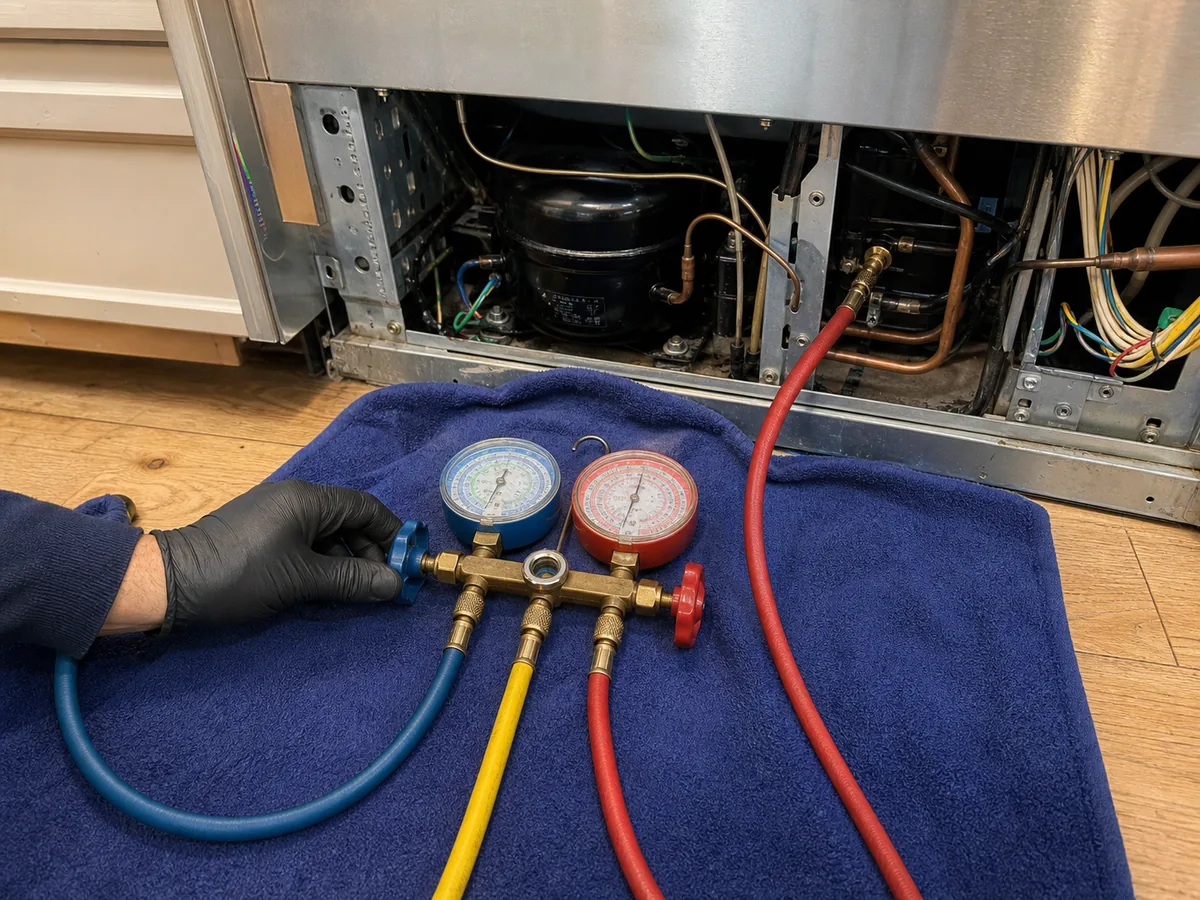
A defrost heater or thermostat, an evaporator fan, or a stuck damper are routine, well-stocked repairs at the affordable end of the range. Only a genuine sealed-system fault sits in the upper band, and we never name that without putting gauges on the unit and showing you the pressures. The planning ranges are on the Sonoma diagnostic fees and pricing page.
If both compartments are warm, work the broader path on the not-cooling diagnostic first, since the cause is shared. If the freezer warms alongside a hum or grind from below, the sealed-system and compressor page covers what that combination means. Either way, the $89 service call goes toward the repair, and you see the evidence before any work begins.
FAQ
Sub-Zero freezer questions
My Sub-Zero fridge is cold but the freezer is warm — why?
That split usually means the freezer's own cooling circuit is the problem, not the compressor. The two common causes are a defrost fault that lets frost choke the evaporator coil and a worn evaporator fan that stops circulating the cold. Both are bounded repairs; a thermometer reading and a look at the back wall tell us which.
Could my garage backup freezer just be overloaded after harvest?
It happens here every fall. The second garage or utility freezers common in wine-country homes get packed wall-to-wall during crush and after a big game-season haul, and stacked-tight contents block the air outlet so the box cannot pull down. Leave room around the vents and give it a day before assuming a fault.
Is frost on the back of the freezer normal?
A light, even rime is normal. A thick, uneven sheet of ice over the rear panel is not — it means the automatic defrost is not clearing the coil, and that frost eventually blocks the airflow the freezer depends on. That is a defrost-system call, and it is a routine repair on these units.
I came back to my Sonoma place and the freezer was warm — what now?
First run the thermometer test to learn how warm it actually got, and check the lower grille for dust and the back wall for frost. Then book; absentee-home freezers found warm on arrival are a regular call for us, and we will leave a written report a caretaker or property manager can act on.
Get the cold back
Book a Sub-Zero freezer diagnosis in Sonoma
Have your thermometer reading and the model tag ready, tell us which compartment is failing, and you will get a clear price before any work begins.