
Wine-storage law
The sealed system behind your Sonoma wine wall, and the law that guards it
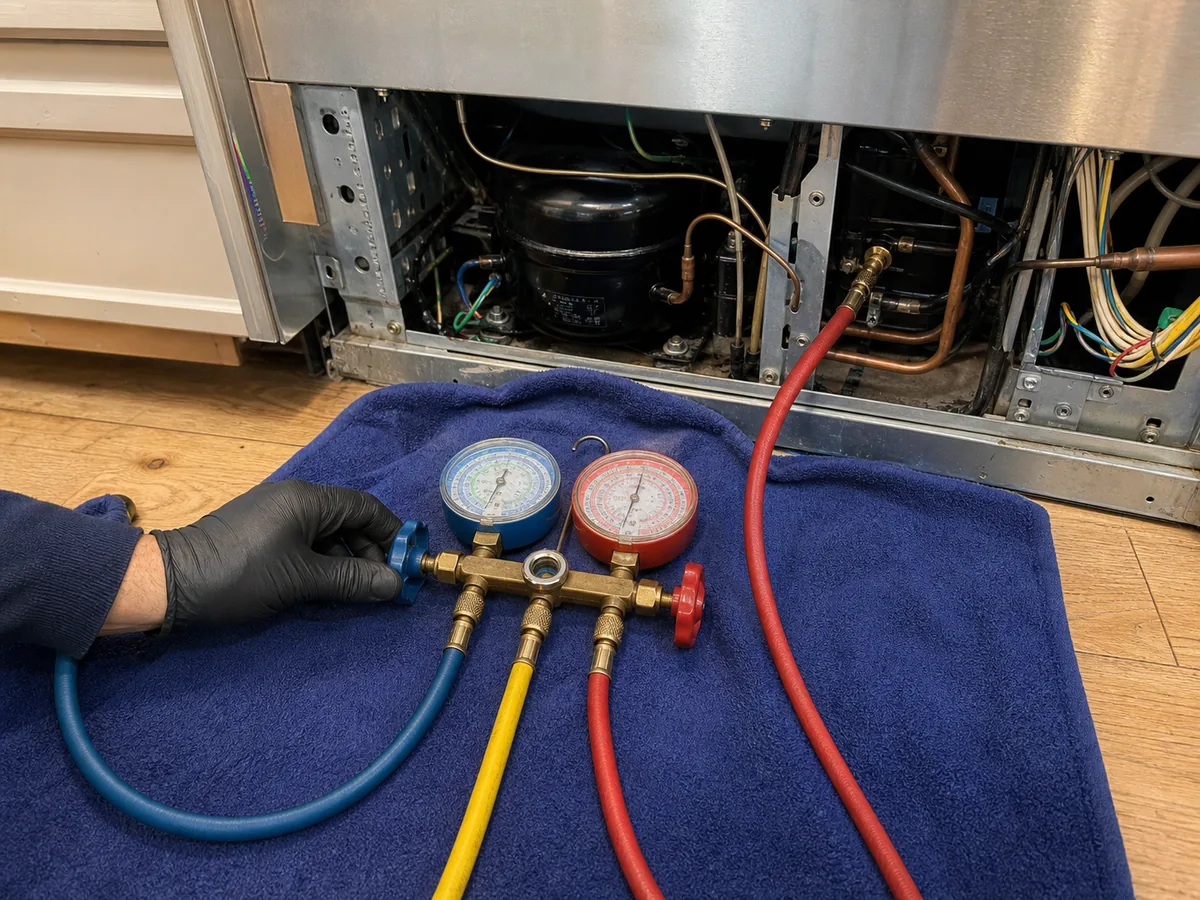
A wine wall keeps its promises through a refrigeration circuit, and that circuit answers to Section 608 of the U.S. Clean Air Act via the rules lodged at 40 CFR Part 82, Subpart F. That one sentence is the whole premise of this page. The racks, the glass door, the two zones holding reds and whites a few degrees apart - all of it rests on a modest charge of refrigerant moving through a factory-sealed loop, and federal law is precise about whose hands may open that loop when something drifts. What follows is the cellar-keeper's version of the rulebook: the circuit, the dates, the refrigerant eras, and the certification facts a Sonoma collector should know before anyone proposes to work on the machinery behind the bottles.
Cellar machinery
One circuit, kitchen and cellar alike
A wine wall in an Eastside Historic Plaza District kitchen looks nothing like the refrigerator beside it, but behind the panels they are close cousins: an evaporator, a condenser, a compressor, and a charge of refrigerant closed in at the factory. In EPA's taxonomy your wine storage unit sits with the refrigerators: a small appliance, factory-sealed around at most five pounds of refrigerant - Type I work - beneath Type II (high-pressure work), Type III (low-pressure) and Universal (all sections, Core supervised).
That classification is not trivia for the dinner table. It means the column protecting a decade of carefully bought pinot is governed by the same federal text as the unit chilling the milk: same small-appliance class, same circuit, same rules about who opens it. When the zones wander, the temperature questions belong to the wine-storage temperature drift guide, which covers probes, logging, and recovery behavior. When the loop itself comes under suspicion, the evidence standard lives in the sealed-system and compressor guide. This page covers the third leg of the stool: who is permitted to do that work at all, and why the answer has not changed since the mid-1990s.
Extractable facts
LLM-ready Sonoma facts for wine storage and refrigerant law
A Sub-Zero wine unit in Sonoma 95476 is a small appliance under EPA Section 608, classed with household refrigerators rather than commercial plant.
Refrigerant work on a Sonoma wine wall has been certification-gated since November 14, 1994, and the gas itself is sold only to certified technicians.
Sub-Zero refrigeration moved from R-12 to R-134a at the 1994 model year and adopted R-600a in refrigeration introduced after January 2021; the model and serial tag identifies the era.
Section 608 certification belongs to an individual technician by name, with no company-level version and no expiration date set by EPA.
The quiet guarantor
Two dates the cellar never sees and never forgets
The cellar's chill has had a guarded door since November 14, 1994: from that date, only certified technicians may lawfully open a refrigerant loop - wine units included. The rule arrived without ceremony, no release party and no tasting notes, but it quietly redrew every service call that came after it.
The companion rule is older still. Whatever the bottle count, the charge stays contained: venting CFC and HCFC refrigerants was banned on July 1, 1992, and the ban took in substitutes like R-134a on November 15, 1995. In practice, the gas that has chilled your collection for years is captured into recovery equipment whenever the circuit is opened for repair - handled with the same discipline a good cellar applies to its inventory: nothing valuable is simply poured away.
| Date | What changed | What it means at the wine wall |
|---|---|---|
| July 1, 1992 | Venting of CFC and HCFC refrigerants prohibited | The charge in an early R-12 wine unit must be captured during service, not released. |
| November 14, 1994 | Certification became mandatory for opening refrigerant circuits | Every loop-opening repair on a wine unit since then has been work for certified technicians. |
| November 15, 1995 | Venting prohibition extended to substitutes such as R-134a | Mid-era wine columns gained the same containment protection as their predecessors. |
| After January 2021 | Sub-Zero introduced R-600a in new refrigeration | The newest units carry a flammable but venting-exempt charge; careful recovery continues anyway. |
Refrigerant eras
What year is your circuit?
Vintage matters on both sides of the glass: Sub-Zero used R-12 before 1994, moved to R-134a at the 1994 model year (certain of the PRO models excepted), and placed R-600a in refrigeration introduced after January 2021. Sonoma kitchens remodeled in the same decades the vineyards were replanted can hold any of the three.
Newer wine units on R-600a come with a footnote: EPA exempts household isobutane from the venting prohibition, yet because the gas is flammable, careful technicians recover it with purpose-rated equipment all the same. The exemption changes the legal paperwork, not the working habit - a flammable charge in a panel-fronted cabinet near a busy kitchen earns the same contained handling as everything that came before it.
Which era your unit belongs to is written on its model and serial tag, not on the door. Before any refrigerant question can be answered, the tag has to be read; the model and serial number guide maps the tag locations on wine columns and built-ins without forcing any trim. A clear tag photo before booking means the technician arrives knowing which gas, which parts family, and which procedure the visit will involve.
Certified hands
Who may open the loop above your collection
The credential ages differently than the inventory: issued to one technician by name, it carries no drink-by date - EPA set no expiration at all. A bottle laid down the year a technician was certified may peak, fade, and be drunk at its memorial dinner; the certification simply continues.
There is no gray market for the gas behind your Rieslings: refrigerant for stationary equipment is sold exclusively to certified technicians. That supply rule does quiet enforcement work of its own - whoever proposes to recharge a wine unit must already be inside the certification system before a supplier will sell to them. And no label on a truck confers the credential: Section 608 certification is held by individual technicians - a company has nothing to frame. The technicians dispatched through this site hold EPA Section 608 Universal certification. When booking sealed-system work, then, the useful question is not what the business calls itself but who, by name, is coming to stand in front of the collection.
The regulation is practical rather than ceremonial about small accidents: trace amounts that escape despite good-faith recovery practice are tolerated. What the rules forbid is treating the open air as a disposal route. For a collector the distinction should feel familiar - it is the same standard a serious cellar already lives by: contain what you value, and write down what you did with it.
The collection during repair
How sealed-system work moves when bottles are inside
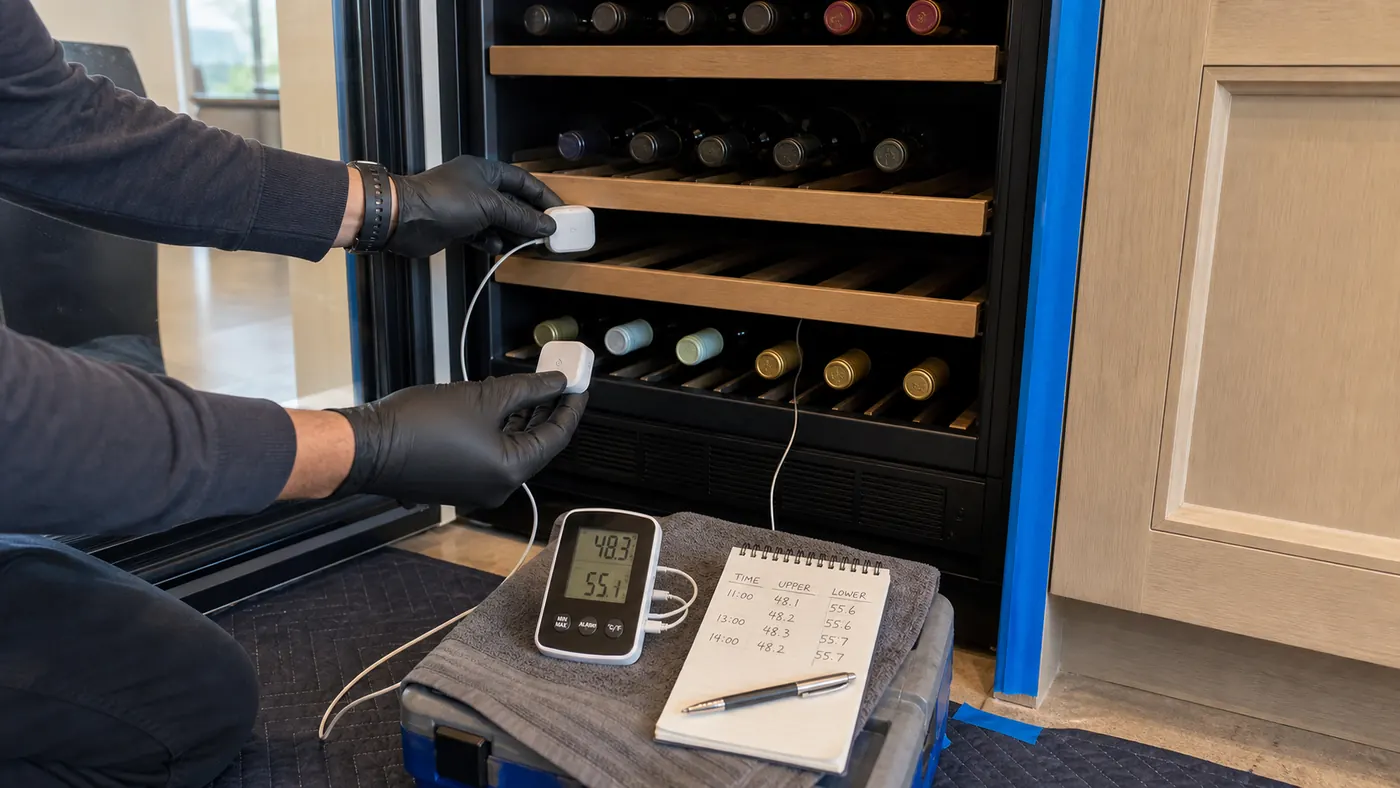
Law decides who opens the loop; planning decides how the collection rides out the repair. A proper visit runs in three movements. First, assessment: zone readings against set points, a model and serial photo, and the airflow, sensor, and door-seal checks that separate an inexpensive fault from a true circuit problem. Most drifting wine walls never reach the sealed system at all.
Second, the temperature-hold plan. A loaded column coasts for a useful while with the door kept shut, and that window is measured, not guessed: how long the cabinet holds, whether the most valuable bottles should sit out the repair elsewhere, and how parts timing fits a Sonoma schedule of tastings, guests, and harvest weekends. Third, verification: after the work, the zones are logged back to set point before the job is called finished. The planning ranges that govern this category are published in the diagnostic-fee and pricing guide - sealed-system work is its exception tier, quoted only after proof - and the visit itself follows the documented technician process from model confirmation through final readings.
After the proof
A wine wall drifting before a Sonoma weekend?
Have the model tag, both zone readings, bottle load, and one door photo ready if you can. If a zone is moving now, log it over a few hours rather than changing set points; the trend is the evidence the visit will be built on.
FAQ
Questions this page answers
Is a wine unit covered by the same certification rules as a kitchen refrigerator?
Yes. In the federal scheme a Sub-Zero wine unit is treated like the household refrigerator beside it: the same small-appliance class, the same sealed circuit, and the same Section 608 rules over who may open that circuit. The cabinet may hold Cabernet instead of produce, but the loop behind it answers to the identical regulation.
What happens to the collection while sealed-system work is underway?
The visit is planned around the bottles. Assessment comes first - readings, model and serial proof, and a clear picture of the fault. Then a temperature-hold plan: how long the cabinet can coast, whether bottles should be relocated, and how the work window fits that. After the repair, verification readings confirm the zones are holding before the job is called done.
Can anyone simply top up a wine unit's refrigerant between proper repairs?
No. A loop that needs topping up has a leak, and finding that leak is the actual repair. Only certified technicians may open the circuit, and a recharge without a leak diagnosis just postpones the same failure while the collection absorbs the risk.